

Hands-On Learning at Quinnipiac Clinic

As health-care workforce shortages and access gaps continue to grow nationwide, efforts to address them have taken shape in unexpected places—including at a student-run clinic led in part by Alyssa Campo.
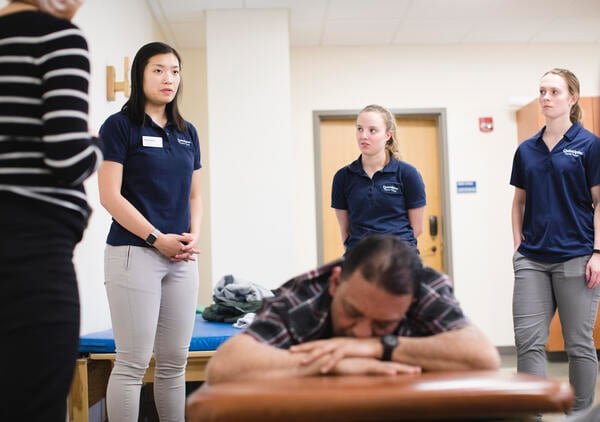
Each Tuesday from 4 to 7 p.m., the doctoral student at Quinnipiac University helps lead a rehabilitation clinic. Alongside roughly 60 fellow volunteers, she provides physical therapy to uninsured and underinsured patients who might otherwise go without care, gaining hands-on clinical experience in the process.
“[The clinic] really allows us to work with a wide variety of patients from many different backgrounds,” Campo said. “Without us treating them, they’re not getting care and they’re not getting better, so it allows us to really make an impact in somebody’s life.”
Linda Bedard, clinical assistant professor of physical therapy at Quinnipiac, said the EQUIP Rehabilitation Clinic began in 2012 as a student capstone project and saw a surge in volunteer support beginning in 2021.
Today, more than 80 percent of the university’s doctor of physical therapy students volunteer at the pro bono clinic while completing a demanding graduate curriculum. Under the supervision of licensed faculty and alumni, they have provided full physical therapy services to more than 400 patients.
“It started off with students saying, ‘Wow, wouldn’t this be really cool to have a free clinic where clients could come and students could learn?’” said Bedard, who oversees the clinic. “From there, it has really expanded and been enriched.”
“Our health-care delivery system in the United States really is a struggle for a lot of people who are uninsured or underinsured,” she added. “There were plenty of clients who actually needed our services if we could do it free of charge, so filling that gap has been a win-win for everybody.”
Bedard said the clinic gives students sustained clinical decision-making experience—evaluating patients, planning treatments, completing documentation and providing follow-up care—while also helping them build a professional identity and a strong service ethic.
“It’s such an intensive program, so [the clinic] is a way for students to immediately see something that they’ve learned about in class and then see it on a real client, which strengthens that integration of learning,” Bedard said.
Inside the clinic: Campo said the clinic allows her to experience patient conditions that can’t be simulated in class.
“We’re practicing on each other, but there’s only so much that you can feel and get a tactile taste for when everyone’s healthy in your class,” Campo said. “EQUIP gives us the opportunity, from the very beginning, to feel what high muscle tone feels like, to feel what a limited range of motion with a firm end feel feels like.”
Bedard said the clinic treats a large population of Spanish-speaking patients, so students also learn to communicate across language barriers and adapt care for diverse communities.
“How can we get translation? How can we do that through visual demonstration?” Bedard said. “It’s been a great awakening that not everybody’s primary language is English … so I believe that really helps students see all walks of life encompassed in our health-care delivery system from an equity perspective.”
She added that seeing real-world examples—from a patient who experienced a devastating accident to one recovering from a stroke and struggling to communicate their worries—gives students more perspective and clarity.
“You can’t mimic that easily in a classroom,” Bedard said. “It’s a safe space to trial and error and to be given immediate gentle feedback. You can track your own progress week over week with a patient, and from there, students’ confidence really grows.”

Quinnipiac University’s student-run clinic helps physical therapy students build professional identity and a strong service ethic.
Building skills through service: Bedard said the clinic illustrates how academic programs can strengthen workforce readiness while meeting community health needs—without adding cost to students.
She noted the “altruistic” nature of the clinic, emphasizing that the university does not fund it; all expenses are covered by donations and charity events the students organize.
“Students are really busy, but they are there because they want to be, not because they have to be,” Bedard said. “They don’t have to take part in doing this. They’re doing it out of the goodness of their heart.”
“They’re learning that accountability and social responsibility are needed in the health-care delivery system and how to be empathetic to where a patient might be [in their recovery],” she added.
Campo agreed, adding that the experience teaches students the importance of giving back while developing professional skills.
“It makes you feel very good inside,” Campo said. “As Linda likes to say, it gives you the warm fuzzies because these patients would not be able to receive care otherwise.”
Get more content like this directly to your inbox. Subscribe here.
You may be interested

Prosecutors from Jeanine Pirro’s office tried to access Federal Reserve headquarters, but were turned away
new admin - Apr 15, 2026Prosecutors from U.S. Attorney Jeanine Pirro's office visited the Federal Reserve's headquarters unannounced Tuesday and attempted to gain access to…

On the ground look at Colorado pileup involving over 75 vehicles
new admin - Apr 15, 2026Over 75 vehicles in Colorado were involved in a major pileup on Tuesday afternoon. At least 19 people were injured,…

“The noose is getting tighter” on Iran amid blockade, Middle East expert says
new admin - Apr 15, 2026The White House said more than 100 empty oil tankers are heading to ports in the U.S. to load up…