


You need to listen to Laurie Spiegel’s masterpiece of early ambient music

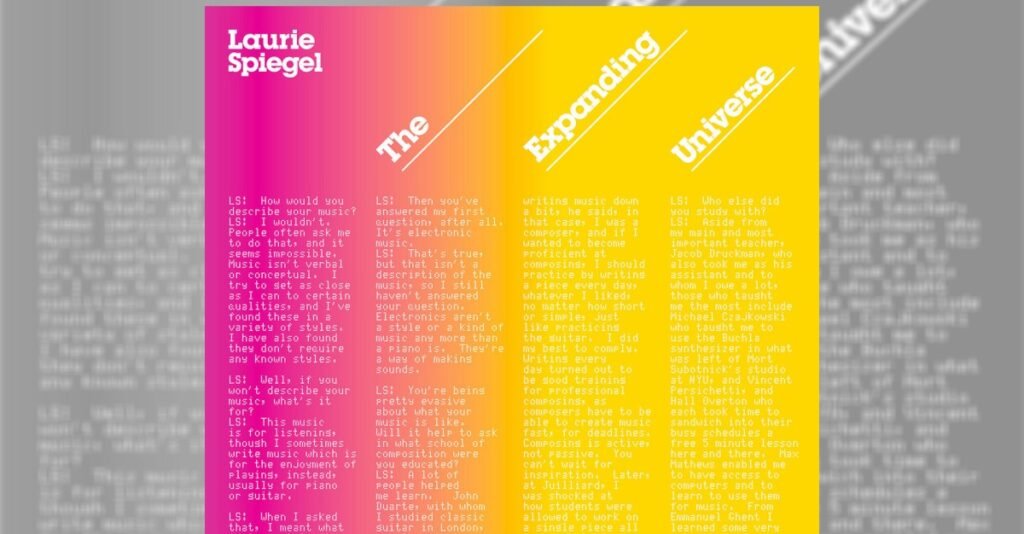
I recently had the pleasure of interviewing Laurie Spiegel for the site. As preparation for the interview, I spent a lot of time over the last couple of weeks revisiting Spiegel’s records, most notably The Expanding Universe, her 1980 masterpiece that blends synth experimentalism with early examples of what would eventually be called ambient music, and algorithmic composition techniques. It’s a marvel that sounds both nostalgic and cutting-edge at the same time.
Tracks like “Patchwork” and “A Folk Study” dabble in the sort of bouncy arpeggios that beg comparisons to The Who’s “Baba O’Riley,” while “Old Wave” and “East River Dawn” conjure early M83 or Boards of Canada. The palette she draws from is buzzing with life and timeless, rarely dating itself in the way her later (also excellent) record Unseen Worlds does, as it occasionally dabbles in FM bells.
There are also slower forays into more typical ambient sounds like “Appalachian Grove II” or “The Unanswered Question,” whose melodies move at such a glacial pace that they can feel almost completely random at times. Tracks like these and “Music for Dance II” wouldn’t feel out of place on modern ambient Instagram or modular synth YouTube, scenes that obviously owe a lot to Spiegel’s pioneering works.
While the vast majority of the tracks completely lack percussion, there are a few exceptions, most obviously the fast-paced and polyrhythmic “Drums.” But the standout to me is “Clockworks,” which ventures into the sort of proto-industrial grime and rattle you’d find on a Throbbing Gristle record or even a modern Trent Reznor score. The fact that it doesn’t appear to have been sampled (at least according to WhoSampled) and repurposed as the backbone of an underground hip-hop track is shocking to me.
While The Expanding Universe doesn’t necessarily present a cohesive vision, it still feels like the singular expression of an artist at the height of their game. The 2012 reissue adds to Spiegel’s legacy by including over 100 minutes of additional material not on the original release.
While the idea of 70s experimental synth music might scare off casual listeners, there is something inviting about a lot of the works on The Expanding Universe. Sure, some tracks, like the one-two punch of closers “Kepler’s Harmony of the Worlds” and “Wandering in Our Times,” aren’t afraid to sit for extended periods in dissonance and confrontational tones, but for the most part, Spiegel’s compositions are tuneful and approachable.
You may be interested

Here’s what Samsung’s smart glasses actually look like
new admin - Jul 22, 2026Samsung has given us our first chance to check out its upcoming smart glasses in person, revealing two new designs…

Horse trainer discovers pre-dug grave of missing teen on remote California trail
new admin - Jul 22, 2026It was Labor Day weekend 2003 when Matt Scribner, a local horse farrier and trainer who also competes in long-distance…

Denver Broncos 2025: Jaylen Waddle trade and over 9.5 wins betting
new admin - Jul 22, 2026[ad_1] NEWYou can now listen to Fox News articles! We are at team number three in this journey of trying…