



National Institute on Transfer Finds a New Home

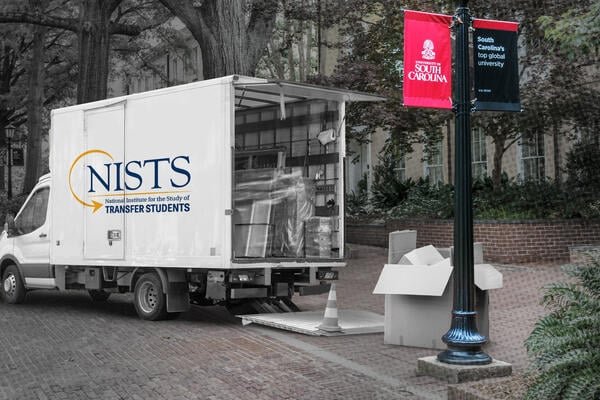
The National Institute for the Study of Transfer Students is moving to USC’s National Resource Center for the First-Year Experience.
Photo illustration by Justin Morrison/Inside Higher Ed | MarioGuti and Wolterk/iStock/Getty Images
When the National Institute for the Study of Transfer Students lost university funding and its home base at the University of North Georgia last year, supporters worried transfer student success would suffer. For two decades, NISTS had connected scholars who study transfer with the campus staff who facilitate it, disseminating resources and research to improve the process for students nationwide.
But NISTS has since found a new home. The National Resource Center for the First-Year Experience and Students in Transition (NRC) at the University of South Carolina agreed to sustain NISTS’s legacy for years to come, including taking over much of its programming and resources for transfer professionals.
“I didn’t want to see decades of really important knowledge-building disappear,” said Kate Lehman, executive director of the NRC. “Transfer is just an increasing part of the conversation in higher ed, and to lose that resource—it just was unconscionable to me.”
After NISTS announced plans to close last October, multiple organizations came forward and offered to help continue its work.
But the NRC won out because the two organizations have significant overlap in their missions and already have long-held “professional relationships grounded in mutual respect,” said Janet Marling, NISTS’s former executive director. “I could not be more thrilled [about] how things have landed.”
The NRC has historically produced scholarship and guidance on first-year experience courses but also focuses on improving student transitions more broadly, including their transfer from one institution to another. The center was working on building up its programming and resources related to transfer when NISTS fell on hard times and needed a new home.
The NRC’s absorption of NISTS “bolsters some of the really great work they’ve already been doing in this area” and “builds on where they’ve been headed,” Marling said. The partnership “also gives them a very large collective set of knowledge and an entire community to think about serving in new ways, which I think only increases their importance to the field.” For NISTS, “it allows for the work to continue.”
J. Rex Tolliver, the University of South Carolina’s vice president for student affairs and academic support, said the move also bodes well for “the reach and reputation of USC as a leader in student success.”
“This moment reflects our enduring commitment to excellence in research, practice and partnership and signals to the national higher education community that USC continues to shape how institutions support students through critical transitions from their first year to transfer and beyond,” Tolliver said in a press release.
Going forward, NISTS won’t retain its name, but many of its offerings will continue. The NRC took over NISTS’s website to make sure its reports and resources remain available and will slowly transition those documents to the NRC’s site, Lehman said. The NRC hired NISTS’s assistant director, Emily Kittrell, as a transfer expert in residence to lead the integration effort. And while the NRC is still hashing out the details, NISTS’s beloved annual conference will live on in some form; the NRC plans to either add transfer-related programming to its existing conferences or create a separate event.
“I’m really committed to having some sort of in-person event,” because “that was really the hallmark” of the institute, Lehman said.
To facilitate the transition, NRC hosted a welcome webinar for members of the NISTS community last month, recognized NISTS’s team at its First-Year Experience Conference this week and held a listening session at the conference about NISTS’s integration.
The goal is to preserve NISTS’s offerings “in a way that elevates the work they were doing, honors the transfer champions they served and preserves the most important aspects” of their mission, Lehman said. “I hope to co-construct whatever this future looks like” with the people who relied on NISTS’s resources.
At a time of closures and mergers, when higher ed doesn’t always have enough resources to go around, “this is a really interesting example of two higher ed organizations coming together for the greater good,” Lehman added, “and figuring out in this shifting environment how to collaborate and maximize the resources we do have to advance our mission.”
You may be interested

5 new supermarket stores to open in 24 hours with 14 more to follow
new admin - Feb 18, 2026A retail giant has announced its new major expansion across the UK. Within this plan, five new branches of the…
UCLA CFO Out After Claiming Administrators Mishandled Money
new admin - Feb 18, 2026[ad_1] The former CFO said UCLA was facing a $425 million deficit in its annual operating budget. The chief financial…

Winds fuel powerful Oklahoma wildfire and force evacuations
new admin - Feb 18, 2026Winds fuel powerful Oklahoma wildfire and force evacuations - CBS News Watch CBS News Strong winds pushed a wildfire across…