




Replacement space station crew takes off on eight-month mission


With NASA’s delayed Artemis II moon mission on hold, SpaceX pressed ahead with a Friday the 13th launch of four fresh crew members to the International Space Station in a mission to replace four fliers who came home early last month because of a medical issue.
Crew 12 commander Jessica Meir, pilot Jack Hathaway, European Space Agency astronaut Sophie Adenot and Russian cosmonaut Andrey Fedyaev, strapped into a SpaceX Crew Dragon capsule atop a Falcon 9 rocket, blasted off from pad 40 at the Cape Canaveral Space Force Station at 5:15 a.m. EST.
NASA 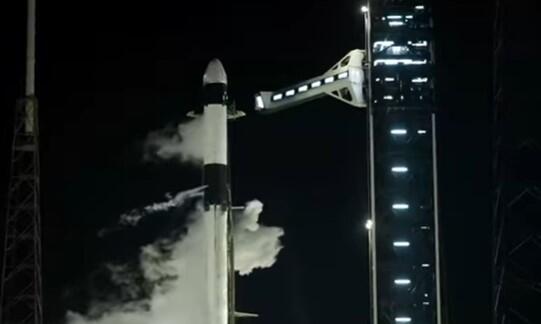
Lighting up the pre-dawn sky, the Falcon 9 streaked away on a northeasterly trajectory aligned with the space station’s orbit, on course for docking Saturday around 3:15 p.m. to boost the lab’s crew from three back to a full complement of seven.
Crew 12 originally expected to take off after four other astronauts ventured to the moon and back in NASA’s Artemis II mission. But the moonshot was delayed to early March because of hydrogen fuel leaks in that crew’s huge Space Launch System rocket. That, in turn, cleared the way for NASA to move up Crew 12’s launch to Feb. 11.
But high winds off shore in the Atlantic Ocean, where the Crew 12 fliers would have to splash down in an ascent emergency, then prompted NASA to stand down until Friday when calmer seas and lower winds were predicted.
While Crew 12 made final preparations to fly, engineers ran another test at nearby pad 39B Thursday to check the effectiveness of new seals in an umbilical connecting fuel lines to the SLS moon rocket. The seals are intended to prevent the sort of hydrogen leakage seen during a “wet-dress rehearsal” countdown Feb. 2.
NASA did not publicize the test, but the agency said later it did not go as planned because of what sources described as a frozen filter in ground equipment.
The trouble will have to be addressed before engineers can attempt a re-test of the new seals, followed by another full-up dress rehearsal fueling test to clear the way for launch as early as March 3.
REPLACEMENT CREW SETS SIGHTS ON SPACE STATION, BOOSTING STAFF BACK TO SEVEN
In the near term, Crew 12 has its sights set on joining space station commander Sergey Kud-Sverchkov, fellow cosmonaut Sergey Mikaev and NASA astronaut Chris Williams, who were launched to the lab last November aboard a Russian Soyuz ferry ship. They will help the new crew get up to speed on the intricacies of station operations.
Meir and Fedyaev won’t need much help because both are station veterans. Their crewmates are making their first trip to orbit, but Hathaway and Adenot bring a wide variety of operational experience to the table.
SpaceX 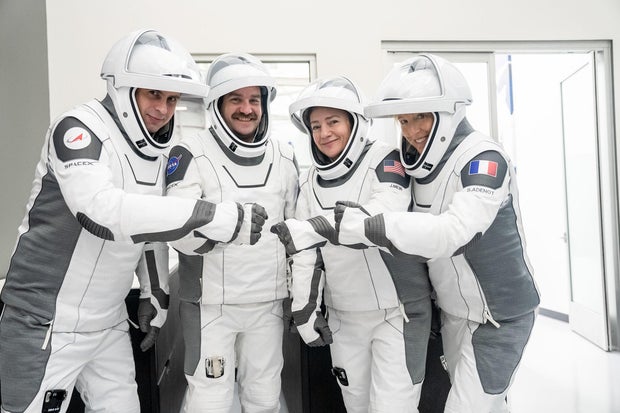
Hathaway is a veteran F/A-18E fighter pilot with more than 500 aircraft carrier landings to his credit while Adenot is a French air force helicopter test pilot with more than 3,000 hours flying time under her belt. She’s also an experienced sky and SCUBA diver and a certified yoga instructor.
Meir holds a Ph.D. in marine biology and participated in three all-female spacewalks during her first station stay in 2019-20. She and Fedyaev are looking forward to helping their rookie crewmates quickly get up to speed when they get to the ISS.
“Both of us are really excited to bring our past experiences and expertise to the very first flight for (Hathaway and Adenot),” she said. “We love this kind of balance that we have, of two veterans and two rookies, to hit the ground running when we get aboard the International Space Station.”
Fedyaev, who flew to the space station aboard a Crew Dragon in 2023, was added to Crew 12 in December, after veteran cosmonaut Oleg Artemyev was removed for reportedly violating security restrictions during training at SpaceX’s Hawthorne, Calif., headquarters. Roscosmos, the Russian space agency, said only that Artemyev was reassigned to other work.
Fedyaev’s prior experience and training with SpaceX and NASA allowed him to join Crew 12 with little impact on launch preparations.
EARLY RETURN OF ONE STATION CREW PROMPTS ACCELERATED LAUNCH OF REPLACEMENTS
Crew 12 is replacing Crew 11 commander Zena Cardman, co-pilot Mike Fincke, Japanese astronaut Kimiya Yui and cosmonaut Oleg Platonov. Crew 11 originally was expected to return to Earth around Feb. 20, after a “handover” with their Crew 12 replacements.
But NASA ordered Cardman and company back to Earth on Jan. 15 after one of the Crew 11 fliers experienced an undisclosed medical issue. Crew 11 came down safely and all four crew members appeared healthy and in good spirits at a post-flight news conference.
But their departure left the station with a single NASA astronaut aboard — Williams — to operate systems in the U.S. segment of the complex. It also brought NASA research to a virtual standstill.
“What it means is, really, there’s just fewer hands on board to do some of the work,” said space station Program Manager Dina Contella.
“On the U.S. operating segment, if we were to have a major failure, then we would like to have a second USOS crew member to be able to go out and perform a complex spacewalk.”
At present, she said, there are no major problems aboard the space station. Even so, NASA asked SpaceX to move the Crew 12 launch up by a few days to get the station crew back to full strength as soon as possible.
Before the Artemis II launch was delayed, NASA was planning a ship-to-ship call between the moon-bound astronauts and the space station crew. That should still be possible despite the moon mission delay.
ASTRONAUTS FACE BUSY SCHEDULE IN ORBIT
Meir certainly hopes so, because her partner during those all-female spacewalks was Artemis II crew member Christina Koch. And her astronaut class included Artemis II pilot Victor Glover and she said she’s close friends with commander Reid Wiseman and Canadian astronaut Jeremy Hansen.
“I would be really excited to be able to talk to Christina, and also my classmate Victor Glover and kind of my astronaut uncles, Reid Wiseman and Jeremy Hansen,” she said before the moon mission slipped to March. “We’re all very excited to be all in space at the same time.”
NASA 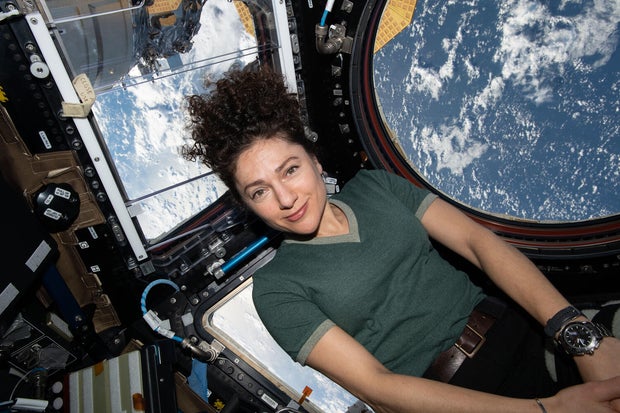
But mostly, Meir is looking forward to the science her crew will conduct during a roughly eight-month stay aboard the space station.
“We will do experiments ranging from bone and muscle health, (studying) our blood flow, what’s going on in all of these systems during the changes that we experience in microgravity,” she said.
“There’s an experiment that’s looking at the small muscles in our necks and how they can support us in different gravitational phases. There will be images of our brains taken pre and post flight to look at any changes to the brain that happened during microgravity and space missions.”
The astronauts will continue ongoing studies of how microgravity affects the vision of some long-duration fliers, apparently by changing the shape of the eye over time. Interestingly, those changes are not always for the worst.
Meir said she needed glasses before her first flight, but her vision improved to 20-15 over the course of her stay in space.
“Pretty interesting for me, it actually turned out to be quite advantageous,” she said. “But of course, we’re studying this really thoroughly, because we want to make sure that we don’t have any long-term damage to astronauts’ vision, or to the eye themselves.
“The good thing is, we haven’t seen any deficits long term that exist beyond the missions, but we need to collect more data.”
The crew will also test a new exercise machine developed by the European Space Agency that’s designed to help astronauts stay fit during future flights to the moon and Mars. And they will work with landing simulator software to learn more about how microgravity might affect astronauts setting down on the moon or Mars.
Jessica Meir 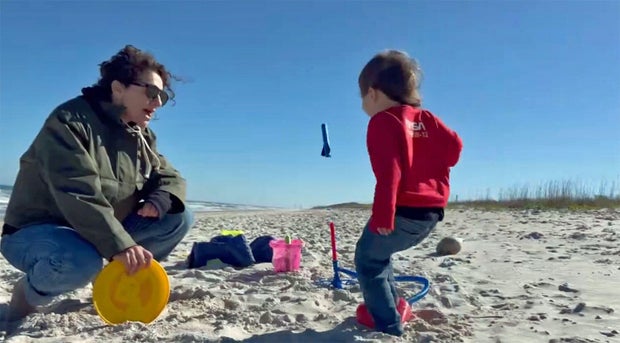
“We even have a new experiment called Relax Pro that Sophie and I will be participating in that’s looking at meditation and mindfulness and how that can benefit astronauts on space missions,” Meir said.
But it won’t be all work. Meir is bringing a piccolo with her and Fedyaev plans to play a harmonica he brought aboard on his first flight.
Along with the harmonica, “there were three guitars during our previous mission on board, Fedyaev said. “We used to sing together, and it was like karaoke.
“We sang different languages, or I would play the guitar, and everybody would sing the words from the song they looked up online. So we will probably meet and play our musical instruments and maybe actually give a concert.”
Adenot will be the second French woman to fly in space. Physician Claudie Haigneré, one of seven French astronauts chosen in 1985, spent 16 days aboard the Russian Mir space station in 1996. Adenot said Haigneré has acted as a sort of mentor for her and planned to attend the Crew 12 launch.
“I remember very well the first launch of Claudie Haigneré,” Adenot said. “I was 14 years old, and that day it kind of clicked in my mind. She was the first French woman astronaut flying to space and before, only men.
“And you know, when you’re a teenager, you’re just looking for inspiration, and if someone has done it already, then it clicks in your mind: say, if a woman has done it already, then why not me?”
Meir also dreamed of spaceflight when she was a child and said she can’t wait to get back aboard the space station.
“When I flew last time, I did not have a husband and a child, and now I have both,” she said. “At the end of my seven months, last time, I actually wanted to stay longer, I wasn’t ready to come home. And this time, perhaps will feel a little bit different since I’ll be leaving my three year old back here.
“But everything that we’re doing on board the space station is so exciting, it keeps us going, keeps us invigorated, and it’s easy to not miss things back at home.
“I hope that what we’re doing will be exciting enough and important enough, noteworthy enough, that one day when she’s old enough, she’ll appreciate that time away.”
You may be interested

Faculty Moving Away From Outright Bans on AI, Study Finds
new admin - Feb 13, 2026[ad_1] Academics are increasingly allowing artificial intelligence to be used for certain tasks rather than demanding outright bans, a study…

Trump pardons 5 ex-NFL players for crimes including drug trafficking
new admin - Feb 13, 2026Washington — President Trump pardoned five former professional football players Thursday - one posthumously - for various crimes ranging from…

Top 10 romantic movies to watch on Valentine’s Day | Films | Entertainment
new admin - Feb 13, 2026Romantic films are uplifting when you're nursing a broken heart, but they can also leave you sobbing into your date's…