



How the opening ceremony Parade of Nations country order works for the 2026 Winter Olympics

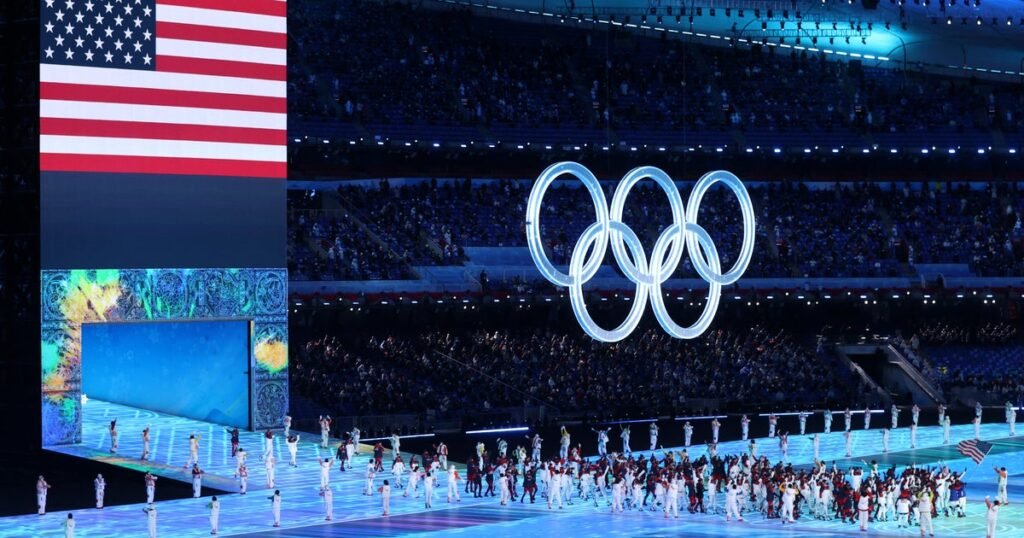
As the 2026 Winter Olympics kick off, viewers from around the world tuned in to watch as nearly 3,000 athletes from countries around the world gathered for the opening ceremony and its traditional Parade of Nations.
Athletes, usually wearing their nation’s official uniforms, march in country by country, led by flagbearers. For Team USA, speedskater Erin Jackson and bobsledder Frank Del Duca were chosen to serve as flagbearers.
The finale comes when the Olympic cauldron is lit using the Olympic torch. This year, there are two cauldrons, one in Milan and one in Cortina, the two host cities in northern Italy.
How is the order of countries in the opening ceremony’s Parade of Nations decided?
The order of countries in the Parade of Nations changes from year to year, with just one constant: Greece always enters first as it is the birthplace of the Games.
After Greece, countries enter in alphabetical order based on the language of the country hosting the Games. In Italian, Japan is spelled “Giappone,” and Hungary is “Ungheria,” meaning that Japan will enter before Hungary, even though Hungary comes before Japan in the English alphabet.
There are a few exceptions to the alphabetical order. The final country to enter is the host country.
The penultimate country to enter is the nation hosting the next Games. In this case, because it’s the Winter Games, France will enter just before Italy because the 2030 Winter Games will be in the French Alps.
While the lineup of nations often includes an Olympic Refugee Team, there will be no Olympic Refugee Team taking part in the Milano Cortina 2026 Olympic Winter Games.
AIN, Individual Neutral Athletes — the term for athletes from Russia and Belarus participating in the Olympics — will not participate in the opening ceremony parade, according to the International Olympic Committee.
How many countries are in the Parade of Nations?
Officially, there are no countries in the Parade of Nations. Rather, athletes from National Olympic Committees – the governing bodies that represent their nations in the Olympic Movement — are considered participants.
There are 206 National Olympic Committees, but fewer participate in the Winter Olympics than in the Summer Games — usually around 90. This year, 92 are expected to participate in the Milano Cortina Games.
History of the opening ceremony and the Parade of Nations
The modern Olympics began in 1896, with the Parade of Nations introduced at the 1908 London Games, according to Mark McDowell, a tour guide at the U.S. Olympic and Paralympic Museum. In the years since, the Parade of Nations has become an integral part of the opening ceremony.
“They worked the balance between national pride and coming together as people of a global world and competing together peacefully,” McDowell said.
Topical Press / Hulton Archive / Getty Images / Topical Press Agency 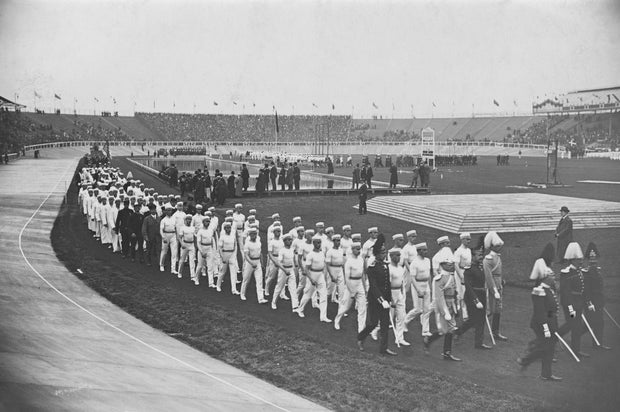
The structure of the opening ceremony has largely remained the same over the years, but there have been some notable changes. In the 1920s, athletes marched with their equipment, carrying skis and skates with them, according to the Olympics. That’s no longer the case.
It was also in 1928 that the tradition of the Greek delegation of athletes marching first was introduced.
One big change has been the scale of the ceremony, McDowell said. Today’s Games have athletes representing many more countries than the earlier Olympics.
The Parade of Nations for the Summer and Winter Olympics are structurally similar, but the Summer Games typically have more athletes because there are more sports during that competition. Athletes are also more bundled up during the Winter Games opening ceremony.
All athletes in the Games are invited to participate, but not all do, McDowell said. It can be physically demanding to be on your feet for an hours-long ceremony the day before competing in a sport.
But for many, being part of the Parade of Nations is a point of pride.
“Many of the U.S. athletes say the opening ceremony, the Parade of Nations, is the biggest lasting impact of the games,” McDowell said. “That sense of pride, camaraderie and going out there for your country is just something that’s hard to replicate.”
You may be interested

Gas prices start to show signs of dropping
new admin - Apr 17, 2026After weeks of enduring high gas prices, drivers appear to be seeing some relief at the pump. Patrick De Haan,…

Tyla, Zara Larsson Name Drop Britney Spears in Song ‘She Did It Again’
new admin - Apr 17, 2026[ad_1] Tyla and labelmate are bringing the Y2K nostalgia in their new collab, “She Did It Again.” The track blends…

Trump continues feud with Pope Leo over war with Iran
new admin - Apr 17, 2026Earlier this week, President Trump turned his criticism toward an unlikely subject- Pope Leo. Michael O'Loughlin, the executive editor of…