


Can Embattled Women’s and Gender Studies Programs Survive?


Texas A&M University’s move last week to close its women’s and gender studies program is highlighting the longstanding vulnerabilities of a field that grew out of the women’s liberation movement of the 1960s and ’70s and raising questions about its future.
While faculty and free expression advocates decried the decision as Texas’s latest assault on academic freedom, conservative pundits praised the program’s demise—as well as the elimination of six additional classes—after a course review found them misaligned with a new system board policy limiting classroom discussions of “race or gender ideology.”
“Texas A & M’s re-examination of its core curriculum and degree programs charts the path forward for other universities that want to ensure their degree programs are high-quality, value-neutral, transparent, and cost-efficient,” Sarah Parshall Perry, vice president and legal fellow at the right-wing organization Defending Education, told Fox News Monday. “Others should follow the university’s example.”
But Texas A&M, which also cited low enrollment as a driver of the women’s and gender studies program’s closure, is already following a trend that started years ago. Since 2023, a spate of other universities—including New College of Florida, Wichita State University and Towson University—have also shuttered their women’s and gender studies programs and departments.
All of these closures have left scholars “saddened, frightened, and enraged about the current state of the field,” according to a 2025 statement from the National Women’s Studies Association (NWSA), “[W]e must not despair. We must resist.”
But given the intensified financial and political pressures to root out all diversity, equity and inclusion initiatives that universities across the country are under, women’s and gender studies scholars expect the interdisciplinary field—and other affinity studies—to face even more scrutiny and program closures in coming years. However, that pressure likely won’t be enough to entirely dismantle the field, which has influenced many other fields over the past 55-plus years.
“What we are experiencing now is an alarming, but not surprising, escalation of nefarious maneuvers meant to repress our reach and impact such as demonizing our field and our scholar-practitioners, distorting our theories, and banning the use of inclusive language to defund our research,” Jessica N. Pabón, president of NWSA, said in an email to Inside Higher Ed.
Scholars believe much of that backlash stems from the field’s aim to interrogate the gender and sexuality norms that the Trump administration and its allies are trying to mandate through policies that stifle academic research and classroom discussion about women and the LGBTQ+ community.
“Our field poses questions and produces knowledge that directly challenges systems of power that rely on the subjugation and exploitation of some to the benefit of the most privileged in society,” Pabón said. “Our scholarship is meant to inform and empower the populations that those in power (i.e., the ones attacking our field) control, discipline, and punish for questioning the social order, the status quo.”
It’s not possible to put this cat back in the bag. We’re never going to get rid of the study of gender. It’s just too integrated into many things—and women won’t have it.”
Joan Wolf, an associate professor in the sociology department at Texas A&M
A History of Critiques, Attacks
Attacks on scholarship about women, gender and sexuality are nothing new.
In 1933, shortly after Adolf Hitler ascended to power in Germany, the Nazis looted and burned the entire contents of the Institute for Sexual Science in Berlin. In the 21st century, numerous other countries, including Russia, Brazil and Hungary, have taken the anti-gender studies torch. For instance, in 2018 the Hungarian government withdrew accreditation from gender studies program, with one official remarking that it “has no business [being taught] in universities,” because it is “an ideology not a science.”
And as American politics has drifted further to the right in recent years, the discipline has become a favorite target of right-wing criticism here.
Even before the second Trump administration issued executive orders broadly banning DEI and “gender ideology” in higher education, Republican lawmakers in Wyoming and Florida had already attempted to defund women’s and gender studies programs, accusing them of indoctrinating students and questioning the degree’s worth. In 2023, New College’s board of trustees voted to eliminate the gender studies program after Christopher Rufo, a New College of Florida trustee and vocal DEI opponent declared, “There is great historical precedent for abolishing programs that stray from their scholarly mission in favor of ideological activism.”

Independent Picture Service/Universal Images Group/Universal Images Group Editorial/Getty Images
One year later, Florida governor Ron DeSantis ordered the state to study the return on investment of remaining gender studies programs and other majors, such as nursing, computer science and finance, asserting that “It’s not fair [that] the taxpayer,” referencing truck drivers specifically, should pay for student loans “for someone’s degree in gender studies.” (According to the U.S. Bureau of Labor Statistics, graduates of cultural and gender studies programs earn a median annual income of $63,000 compared to $66,000 median for all graduates with a bachelor’s degree.)
But skepticism about the value of women’s and gender studies predates the Trump administration.
“We are accustomed to this false idea that studying gender or studying sexuality in an inclusive and intersectional manner is not ‘real’ research,” Pabón said. “We’ve received this critique from many of our academic peers for the entirety of our existence, a sentiment that comes from the eugenicism and biological essentialism that have kept women, gender expansive folks, disabled, and racially minoritized folks outside of the classroom, textbooks, and canons of intellectual work.”
Challenging those sentiments is what spurred the creation of the field more than 50 years ago as more and more women gained access to higher education, entering graduate programs and getting hired as faculty.
“When they got into these positions, they began to ask questions about the history of women,” said Carrie Baker, chair of the women, gender, and sexuality program at Smith College. “They asked ‘Where are the women in literature? Where are the women writers? Where are women in history?’”
So, they developed courses to fill in those gaps across an array of disciplines, such as history, medicine, anthropology and sociology. In 1970 San Diego State University launched the first women’s studies program in the country. More followed, and as of 2023 there were more than 800 such departments and programs, according to data from the NWSA.
“The influence of Women’s Studies has touched almost every traditional academic field,” Baker said. For example, “the fact that we now do medical studies on women at all is due to [those critiques].”
Knowledge is a tricky thing to control. You can refuse to fund certain types of research and can cancel classes, and people will find alternative ways to share and make new knowledge.”
Amy Reid, program director of PEN America’s Freedom to Learn initiative
‘More Necessary Now’
And despite the recent criticism, enrollment in women’s and gender studies courses was on the rise as of 2023, the latest year for which data is available.
“Women’s and gender studies is more necessary now than ever to understand what’s going on,” said Baker, adding that enrollment in her courses doubled after Trump was elected. “The policies of the Trump administration hurt women and those hurt women are going to need us. … Going backward on gender issues is going to put a lot of women in bad situations.”
However, enrollment numbers in most of these programs still look small compared to more mainstream majors. And many universities have cited low enrollment as the reason given for closing women’s and gender studies programs; Texas A&M, for instance, noted that its program has just 25 majors and 31 minors enrolled prior to announcing plans to wind it down last Friday.
“One of the biggest reasons why we have low enrollment is that we have no resources and students don’t even know we exist,” said Joan Wolf, an associate professor in the sociology department at Texas A&M who has taught women’s and gender studies courses there for decades. “We’re not going to have as many majors as something like psychology, but that’s never been the case.”
Often, women’s and gender studies exists as a program, not a department, as is the case at Texas A&M. That typically means faculty have shared appointments in other departments, leaving programs with small budgets and reduced ability to advocate for more resources. Nonetheless, the classes they offer help to round out students’ education.
“The big service women’s and gender studies do is in the minors,” Wolf said. “I’ve had students pursuing careers in marriage counseling, gynecology and business who want to understand the social dimensions of gender.”

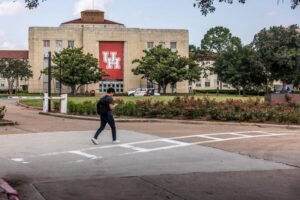
The Texas A&M program cuts follow a new policy that restricts the teaching of race and gender.
Jason Fochtman/Houston Chronicle via Getty Images
However, eliminating the women’s and gender studies program at Texas A&M or elsewhere won’t stop students and faculty from considering gender in their scholarly work and beyond.
“It’s not possible to put this cat back in the bag,” Wolf said. “We’re never going to get rid of the study of gender. It’s just too integrated into many things—and women won’t have it.”
But the field’s success in influencing so many other fields, doesn’t justify dismantling it either, said Amy Reid, program director of PEN America’s Freedom to Learn initiative and former director of the now-defunct gender studies program at New College of Florida.
“Gender Studies, women’s and gender studies, have a methodology that is distinct from the methodology of other disciplines,” she said. “It allows people to expand beyond the disciplinary bounds of any one field, and that creative synthetic process is important for students who are trying to learn.”
And that’s also the value-add of other disciplinary fields—such as Black studies, Indigenous Studies and Middle Eastern studies—which like women’s and gender studies, sprang from the entry of nonwhite scholars to the professoriate in the mid-20th century after racial segregation was outlawed.
While the professoriate has become more diverse in terms of gender, race and ethnicity, those gains are “connected to the devaluing of higher education as a field,” Reid said. “When higher education was the domain of white men, it was seen as more prestigious; as women and people of color have gotten footholds in higher education, lo and behold, the salaries have gone down and the sector is more vulnerable to attack.”
Reid suspects many of those other affinity fields will also face increased threats and criticisms—if they aren’t already—amid federal and state crackdowns on university curricula. As of last week, the University of Iowa is still reviewing low-enrollment majors, including African American studies and gender, women’s and sexuality studies, for potential elimination or consolidation.
“We are going to see more closures over the next number of years, and we’re going to continue to see our students across the country paying the price,” she said. “But knowledge is a tricky thing to control. You can refuse to fund certain types of research and can cancel classes, and people will find alternative ways to share and make new knowledge.”
You may be interested

Olympic luger Jonathan Gustafson explains the unique skills required to compete in the fastest sport on ice
new admin - Feb 06, 2026Blink and you might miss it. Luge is the fastest sport on ice, where milliseconds matter. So every push, every…

TikTok’s infinite scroll is too addictive, say EU regulators
new admin - Feb 06, 2026EU regulators have declared that TikTok’s “addictive design” may put it in breach of the Digital Services Act (DSA), in…

Pet cam saves home as owners spot dog barking in kitchen
new admin - Feb 06, 2026A couple who were keeping an eye on their beloved dog through a pet camera were left shocked after witnessing…