



Ensign College Expands Its Three-Year Degree Offerings

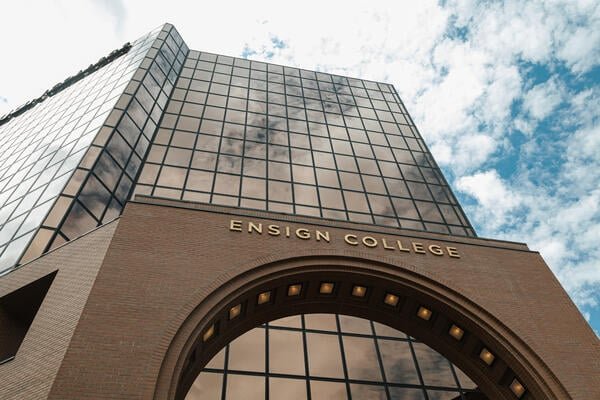
Just months after the launch of the first handful of in-person, three-year undergraduate programs last fall, one university has announced it will offer all of its undergraduate programs as reduced credit “bachelor’s of applied science” degrees.
Starting in spring 2026, Ensign College, a private institution in Utah that is part of the Church of Jesus Christ of Latter-Day Saint will allow students to take any of its 10 majors in a three-year format—although the four-year option will still be available.
The new 90-credit option seeks to “help students graduate faster and start earning sooner, without requiring an overloaded, accelerated course schedule,” according to the college’s announcement.
It’s the first college in the U.S. to offer an accelerated timeline for all its majors. Among the other institutions that have launched or announced plans to introduce three-year degrees, most are relegated to a handful of programs.
Ensign’s announcement comes about two years after it launched two online, reduced-credit programs in spring 2024. At the time, its accreditor, the Northwest Commission on Colleges and Universities, said it would wait to see the outcomes of the program at Ensign—as well as at Brigham Young University–Idaho, which launched its own reduced-credit offerings at the same time—before approving other reduced credit programs. In summer 2025, the accreditor removed the “pilot” label from BYU-Idaho and Ensign’s online three-year programs and announced it would allow other institutions to submit proposals for reduced credit degrees.
“We’re getting to the point when we’ll begin to have graduates soon, but we haven’t had graduates yet,” said Bruce Kusch, president of Ensign College. “We’ve had a lot of student interest and enrollment is good.”
Although still rare, three-year degrees have grown significantly more common over the past year as states and accreditors have begun to approve their creation, in some cases on a pilot basis. Proponents of the programs, which in most cases eliminate electives to reduce credits to around 90, argue that they help students save time and money and enter the workforce earlier.
Skeptics, on the other hand, argue that it’s still unknown whether the learning and post-college outcomes of students with three-year degrees will match those of bachelor’s degree holders, considering no students have yet graduated with a 90-credit degree. Critics have also raised concerns about whether graduate schools and employers are likely to give a truncated bachelor’s the same weight as a four-year degree—although some graduate school leaders have indicated they are open to the possibility.
Kusch said that before launching the new initiative, the institution consulted with committees of employers, known as Program Advisory Boards, that provide guidance on how the college’s degrees align with the state’s workforce needs.
“We met with them: We basically said, ‘This is what we’re thinking, this is what we’re planning—tell us what the skills are that you believe are in demand, tell us what things we need to include in our curriculum. Are there things in our curriculum we don’t need?’” he said. “The time has come for a degree like this that is very much focused on getting our graduates ready for the workforce in very powerful ways.”
Each major’s curriculum was reworked from the ground up to fit the three-year format, Kusch noted; in most cases, the main change was that electives were removed.
Although officials hope the three-year degrees will appeal to their current students, Kusch said he is also optimistic that it will attract new populations, including students with some college credits under their belt who are hoping to secure a credential as quickly as possible.
But one population is locked out of Ensign’s three-year degree programs: international students, whom Kusch said are restricted by regulations about what programs they are eligible to attend. Ensign opted to keep a four-year option available for those students. International students, who make up about 36 percent of the institution’s student body, will have to continue taking the full 120-credit majors unless those regulations change, he said.
Madeleine Green, the executive director of the College-in-3 Exchange, an organization that advocates for three-year undergraduate programs, lauded the expansion of Ensign’s reduced-credit offerings.
“Ensign has been a pioneer in three-year degrees … they have the longest experience of any institution in the country, with BYU-Idaho, in running three-year programs,” she said. “It’s a great thing to see that they’ve decided this was successful and wanted to go all in, so we’ll be watching once again to see how things unfold.”
You may be interested

It was once a segregated bowling alley. After days of protests for equality, tensions erupted.
new admin - Feb 05, 2026In the series "USA to Z," "CBS Mornings" co-host Nate Burleson looks at equality in America. A once segregated bowling…

JLab’s new Bluetooth speaker doubles as supersized headphones
new admin - Feb 05, 2026JLab, a brand best known for its budget-friendly but well-featured wireless earbuds, has announced a new pair of headphones that…
£60 necklace reminds us of Duchess Sophie’s | Royal | News
new admin - Feb 05, 2026[ad_1] The Duchess of Edinburgh has quietly mastered the art of understated elegance, and her latest jewellery choice was a…