


Post–SFFA Minority Enrollment Increased at Flagships

The number of Black and Hispanic students attending institutions with high graduation rates declined slightly in fall 2024.
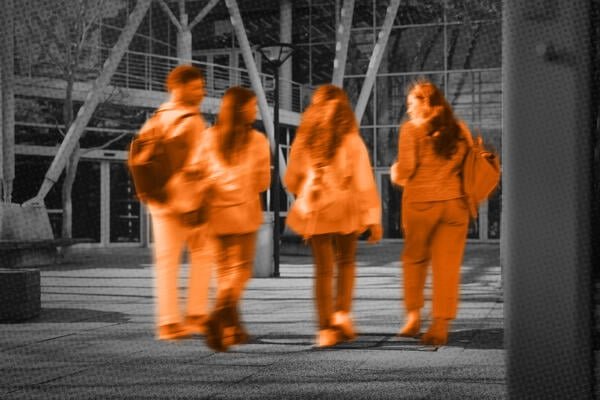
Photo illustration by Justin Morrison/Inside Higher Ed | Jacob Wackerhausen/iStock/Getty Images
Black and Hispanic student enrollment dropped at many of the nation’s most selective colleges following the Supreme Court’s 2023 ban on race-conscious admissions. But in nearly every other sector of American higher education, underrepresented minority enrollment is on the rise, according to new research on fall 2024 enrollment data.
The new research, published by Class Action, a higher education advocacy organization, and led by higher education researcher and Class Action senior fellow James Murphy, analyzed Integrated Postsecondary Education Data System (IPEDS) data for 3,200 colleges, representing over 3 million college freshmen.
At highly selective institutions overall, the number of underrepresented minority freshmen declined 7 percent from 2023 to 2024, including a 16.3 percent drop in Black students and a 1.8 percent decline in Hispanic students. (The fall 2024 freshman class was the first admitted after the decision.)
The decrease among underrepresented minority students was even larger—18.9 percent—at the “Ivy Pluses,” which includes the Ivy League institutions, as well as Duke University, Massachusetts Institute of Technology, Stanford University and the University of Chicago.
The drop in Black and Hispanic students—whom the report focuses on because the total numbers of students of other minority racial backgrounds are too small to be generalized—at highly selective colleges was stark, but not surprising. These decreases are in line with other preliminary research and what experts long anticipated happening as a result of the Supreme Court’s decisions in Students for Fair Admissions v. Harvard and North Carolina.
But Murphy’s research looked beyond the nation’s 93 highly selective institutions to find that for nearly all other types of institutions, Black and Hispanic freshman enrollment grew. That includes both public and private four-year institutions, which experienced increases of 5.9 and 5.8 percent, respectively.
Perhaps most notably, at flagship institutions, underrepresented minority enrollment went up by 8 percent, far outpacing the overall 3.2 percent growth at those institutions. This indicates that Black and Hispanic students who may not have been accepted to an Ivy due to the impacts of the SFFA decision found themselves at top public institutions.
“These really talented Black and Hispanic students who were, in the past, treating the University of Mississippi as their safety school or the University of Michigan as their safety school, because they probably have a better-than-average chance of getting into Wesleyan or Williams or Amherst—suddenly those students aren’t getting into those places,” he said. “So they’re not going to say, ‘well, geez, no college for me.’ They’re going to the schools that they were almost certainly getting into in the past, [but] they just weren’t enrolling in because they were getting into ‘better’ schools.”
It’s a shift from years of declining Black and Hispanic enrollment at flagships, Murphy noted. It also comes at a time that more and more flagship institutions are increasingly becoming seen as attractive destinations for undergraduates and as competitors to the best private research institutions.
It’s likely the career outcomes will not be significantly different for a student who went to Yale University versus a student who went to Michigan, Murphy noted. But that shift may have led to a “cascade” effect in which students who would have attended Michigan or another flagship were instead displaced to less selective institutions.
“While the immediate cascade effect created by a ban on race-conscious admissions may have ultimately increased the diversity of student bodies at a broader spectrum of institutions of higher education, its impact is not wholly positive for underrepresented students of color or for students at highly selective institutions. The latter fail to reap the benefits of diversity while the former may be more likely to enroll in an institution with weaker outcomes than they would have before the Supreme Court decision,” the report reads.
Indeed, in fall 2024, the number of Black and Hispanic freshmen enrolled in universities with graduation rates over 80 percent declined by 1.6 and 1 percentage points, respectively—a smaller but meaningful decrease, Murphy said.
You may be interested

Stealing cable has evolved: the new face of TV piracy
new admin - Feb 04, 2026Walk the rows of the farmers market in a small, nondescript Texas town about an hour away from Austin, and…

Eye Opener: Possible ransom note investigated in Nancy Guthrie’s disappearance
new admin - Feb 04, 2026There are new details in the disappearance of Nancy Guthrie, the mother of "Today" show co-host Savannah Guthrie, as police…
‘Barrage of Bills’ Would Upend Iowa Higher Ed—If They Pass
new admin - Feb 04, 2026[ad_1] Iowa’s legislative session began roughly three weeks ago, and the state’s House Higher Education Committee and its subcommittees have…