


NASA plans on-pad leak repair for grounded Artemis II moon rocket before possible March launch

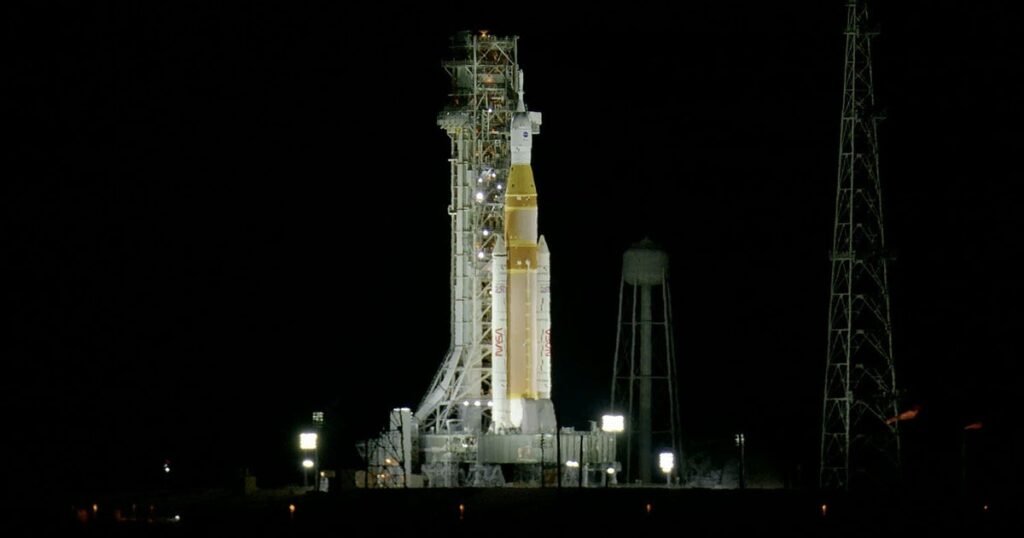
NASA plans an on-pad repair of the fuel leak that derailed an overnight dress rehearsal countdown for the agency’s huge Artemis II rocket. The agency then plans a second fueling test before making another attempt in March to launch four astronauts on a historic flight around the moon.
“We are still in the process of assessing the data that we collected yesterday and developing the (repair) plan,” said Lori Glaze, a senior manager in NASA’s Exploration Systems Development office. “We do believe…at this point that the work that’s in front of us can be conducted out at the pad, and that’s what we anticipate.”
Spaceflight Now 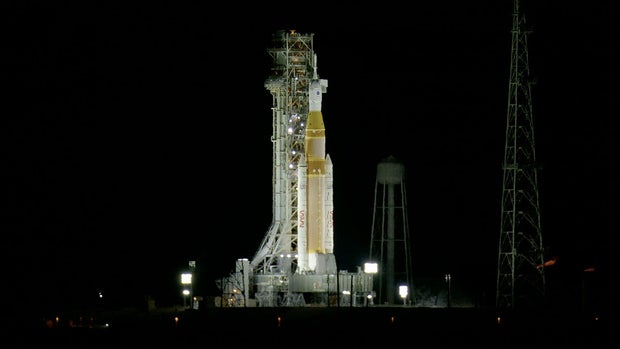
With a February launch ruled out and the moonshot now on hold until March at the earliest, Artemis II commander Reid Wiseman, Victor Glover, Christina Koch and Canadian astronaut Jeremy Hansen ended a pre-flight medical quarantine at the Johnson Space Center in Houston Tuesday.
“Immense pride seeing the rocket reach 100% fuel load last night, especially knowing how challenging the scenario was for our launch team doing the dangerous and unforgiving work,” Wiseman said on X Tuesday afternoon. “The crew just shared a peaceful breakfast with our families and we jump back into training tomorrow to start our preps for a March launch to the moon.”
The leak in question is located between two umbilical plates where an 8-inch-wide hydrogen fuel line enters the base of the rocket. During fueling operations Monday afternoon, sensors recorded high concentrations of hydrogen in a cavity between the ground and rocket sides of the umbilical, forcing fueling to halt.
The team ultimately was able to get the leak back to acceptable levels by adjusting flow rates and temperature, and fully loading the Space Launch System rocket with nearly 800,000 gallons of supercold liquid oxygen and hydrogen fuel.
But the leak suddenly spiked in the final six minutes of the practice countdown when the first stage hydrogen tank was being pressurized as it would be for launch. At that point, an automated control system stopped the countdown and the launch team ended the test without accomplishing several major objectives.
“To me, the big takeaway was we got a chance for the rocket to talk to us. And it did just that,” said John Honeycutt, chairman of NASA’s Mission Management Team. “The test gave us exactly what we needed. It was an opportunity for us to wring out the system, as well as the team, before we ask our crew to go fly.”
Shortly after the test was called off early Tuesday, NASA Administrator Jared Isaacman announced NASA would forego attempting to launch the mission in February and would instead delay the flight until the next opportunity in March when five launch days will be available between March 6 and March 11.
This is only the second flight of an SLS booster, the most powerful operational rocket in the world. During the ramp up to the rocket’s maiden flight in 2022, engineers ran into multiple propellant leaks and other problems that ended up delaying an unpiloted test flight by more than six months.
Hydrogen is the lightest element in the periodic table. It is extremely flammable and it burns very powerfully when combined with oxygen in a rocket engine. But liquid hydrogen is difficult to work with. It’s very cold — minus 423 degrees Fahrenheit — and it easily slips through even extremely tiny gaps in valves and plumbing.
Hydrogen leaks are notoriously difficult to fix because repairs can only be tested by flowing the cryogenic propellant through the pipe, valve or fitting in question at the sort of flow rates and pressures they encounter on launch day. Such testing is only done at the launch pad, and it is a major production.
During the Artemis I campaign, four “wet dress” rehearsal fueling tests were required and the rocket had to be hauled back to NASA’s Vehicle Assembly Building three times for repairs before the rocket finally blasted off.
NASA 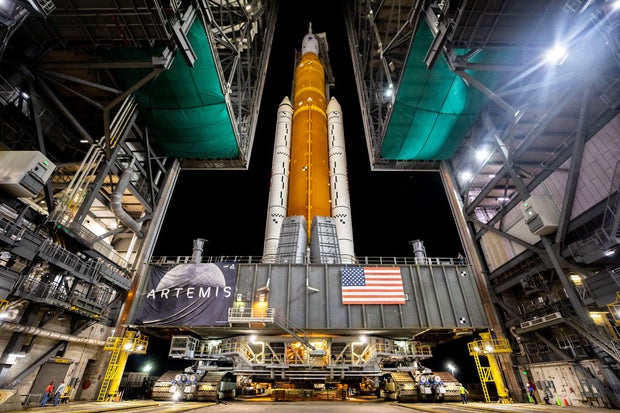
How the Artemis II testing will go remains to be seen. But delaying the launch to March clears the way for a two-man, two-woman crew to blast off next week on a flight to the International Space Station. They’re going to replace four other fliers who had to cut their mission short and return to Earth last month because of a medical issue with one of the crew members.
Crew 12 commander Jessica Meir, Jack Hathaway, European Space Agency astronaut Sophie Adenot and Russian cosmonaut Andrey Fedaev plan to fly to the Kennedy Space Center Friday to begin final preparations. Takeoff atop a SpaceX Falcon 9 rocket is scheduled for 6 a.m. EST on Wednesday, Feb. 11.
But launch will depend on Federal Aviation Administration clearance in the wake of a Falcon 9 second stage anomaly of some sort during a flight Monday to launch another batch of Starlink internet satellites.
Even though the Starlink satellites were successfully deployed, the rocket’s second stage did not operate as expected as it was preparing to fire its engine a third time to drop out of orbit. SpaceX said on X that “teams are reviewing data to determine root cause and corrective actions before returning to flight.”
Crew 12 will use the same type rocket and NASA officials said Tuesday the agency will await clearance from the Federal Aviation Administration before proceeding with launch.
Meir and her crewmates originally were scheduled to take off Feb. 15, but NASA moved the flight up four days after Crew 11 commander Zena Cardman, Mike Fincke, Japanese astronaut Kimiya Yui and cosmonaut Oleg Platonov returned to Earth ahead of schedule in January.
With Crew 11’s departure, a single U.S. astronaut, Chris Williams, was left behind aboard the space station. Williams was launched to the outpost last November aboard a Russian Soyuz spacecraft along with commander Sergey Kud-Sverchkov and cosmonaut Sergey Mikaev.
While Williams is trained to operate U.S. station systems on his own, NASA wants to get Crew 12 launched as soon as possible to resume normal research and to have additional crew members on hand to handle emergencies and to conduct two-person spacewalks.
You may be interested

Extended interview: Jane Doe in R. Kelly’s sex tape reclaims name and shares her story
new admin - Feb 04, 2026Reshona Landfair, who testified as Jane Doe at R. Kelly's 2022 federal trial, speaks to Jericka Duncan in her first…
Mississippi families face prolonged power outages with no way to follow boil-water advisories
new admin - Feb 04, 2026Across parts of the South, prolonged power outages are colliding with boil-water advisories, leaving some families without a way to…

Penny the Doberman pinscher wins best in show at 150th Westminster Kennel Club Dog Show
new admin - Feb 04, 2026A Doberman pinscher named Penny won best in show Tuesday night at the Westminster Kennel Club Dog Show, netting U.S.…