Supreme Court lets Trump fire FTC commissioner for now and takes up blockbuster dispute over her removal

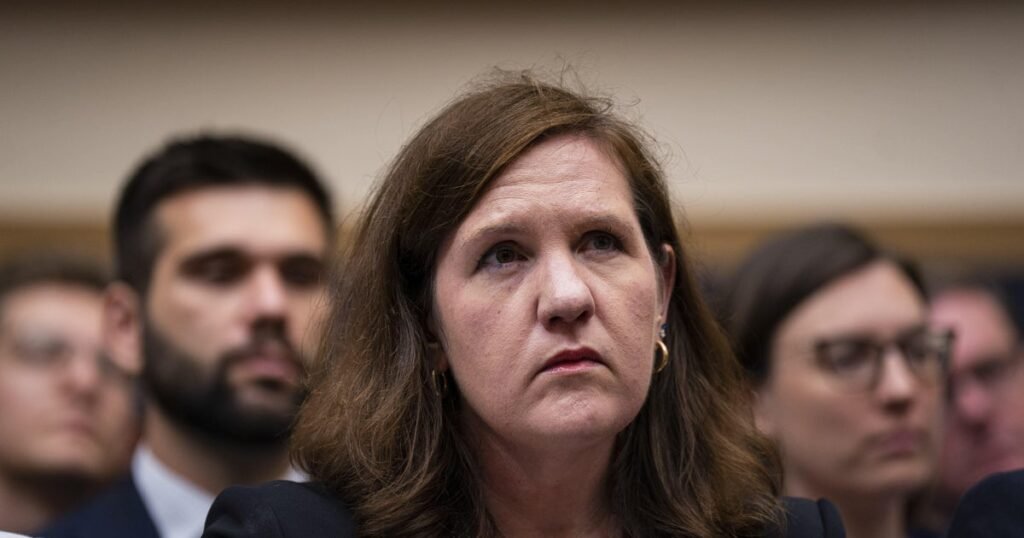
Washington — The Supreme Court on Monday said it will decide whether President Trump can fire members of the Federal Trade Commission without cause, taking up a dispute that tests the president’s removal power and could weaken protections enacted by Congress that aim to insulate independent agencies from political pressure.
The high court said in a brief order that it will also allow Mr. Trump to fire Rebecca Kelly Slaughter from her position at the FTC while it considers the case. It will hear arguments in its December session, and its stay will remain in place until it issues a decision. Justices Elena Kagan, Sonia Sotomayor and Ketanji Brown Jackson dissented from the majority’s decision to allow Slaughter’s removal.
The justices will consider whether removal protections for members of the FTC violate the separation of powers and, if so, whether its 1935 decision that allowed Congress to impose removal protections for officials at independent agencies should be overturned. It will also weigh whether a federal court can prevent a person’s removal from public office, as U.S. district courts have been doing in challenges stemming from Mr. Trump’s firings of Democratic appointees.
In her dissent, Kagan wrote that the Supreme Court has “handed full control” of certain independent agencies that Congress has sought to shield from political pressure to the president.
“He may now remove — so says the majority, though Congress said differently — any member he wishes, for any reason or no reason at all. And he may thereby extinguish the agencies’ bipartisanship and independence,” she said.
Attorney General Pam Bondi cheered the Supreme Court’s decision as a “significant” victory that she said protects the president’s executive authority.
“This helps affirm our argument that the President, not a lower court judge, has hiring and firing power over executive officials,” Bondi wrote on social media. “We will continue fighting and winning in court to defend President Trump’s agenda.”
The dispute arose out of Mr. Trump’s move to oust Slaughter from her position on the FTC. A lower court found that the president’s attempt to fire Slaughter violated a 1914 law that limits the grounds for removing an FTC commissioner to instances of inefficiency, neglect of duty or malfeasance in office, and ordered her to be reinstated. Earlier this month, Chief Justice John Roberts had temporarily paused that lower court order blocking Slaughter’s firing while the Supreme Court considered whether to grant the Trump administration emergency relief.
In its emergency appeal to the high court, the Trump administration urged the justices to swiftly evaluate the constitutionality of the removal restrictions for the FTC before the appeals court has weighed in. Lawyers for Slaughter agreed that the question of whether the protections violate the separation of powers is ripe for the Supreme Court’s consideration.
The case is the latest in a string of emergency appeals that arrived before the Supreme Court in response to Mr. Trump’s efforts to fire Democratic-appointed members of independent agencies at will. The conservative justices have endorsed the president’s removal authority so far, clearing the way for Mr. Trump to fire without cause members of the National Labor Relations Board, Merit Systems Protection Board and Consumer Product Safety Commission despite federal laws protecting them from being removed at will.
Those decisions have called into question the future of the 90-year-old precedent that upheld removal protections enacted by Congress for members of the FTC, the same body on which Slaughter served. In its 1935 decision in the case Humphrey’s Executor v. United States, the Supreme Court said Congress could shield certain officials from being removed by the president without cause.
Lower courts have relied on Humphrey’s Executor as grounds for reinstating officials whom Mr. Trump has attempted to fire. But the steady stream of those decisions prompted calls for the Supreme Court to definitively decide whether the president has the authority to fire the leaders of independent agencies that Congress has insulated from political shifts.
In a concurring opinion in a case involving the removal of three members of the Consumer Product Safety Committee, Justice Brett Kavanaugh warned that “the downsides of delay in definitively resolving the status of the precedent sometimes tend to outweigh the benefits of further lower-court consideration.”
Mr. Trump appointed Slaughter to the FTC in 2018, and former President Joe Biden reappointed her to a second term expiring in 2029.
But in March, Mr. Trump moved to oust Slaughter from her position at the FTC. Slaughter, however, sued, arguing that her firing was illegal because federal law limits a commissioner’s removal to instances of inefficiency, neglect of duty or malfeasance in office.
Lower courts ruled in Slaughter’s favor and ordered her to be reinstated to her position. The Trump administration then sought emergency relief from the Supreme Court.
In court filings, lawyers for the Trump administration argued that the modern FTC exercises “vast executive authority,” a change from the 1935-era commission. The Supreme Court in Humphrey’s Executor said Congress could insulate members of independent agencies from being removed without cause if that entity met certain criteria, including performing only quasi-legislative and quasi-judicial functions.
Solicitor General D. John Sauer argued that the FTC wields “substantial executive authority,” like the other agencies whose members the president has been allowed to remove.
“[D]istrict courts cannot compel reinstatement of agency heads and allow them to purport to exercise executive power when the President has determined they should exercise none,” he wrote.
But lawyers for Slaughter said that for the past 90 years, every president, including Mr. Trump during his first term, has respected the Supreme Court’s finding that the for-cause removal requirement for the FTC is valid under the Constitution.
“The protracted and unanimous acquiescence of all three branches of government in the law at issue here — a law that affirmatively empowers the President to remove commissioners for good cause — defeats Applicants’ assertion that their continued adherence to that still-binding precedent while their appeal is pending would cause them irreparable harm,” they wrote in a Supreme Court filing.
Slaughter’s legal team warned that if she could be fired by the president without cause, the FTC would be “severely wounded and radically transformed.”
The Supreme Court’s 90-year-old precedent provided a narrow exception to the president’s removal authority. But the high court has in recent years chipped away at that ruling.
In 2020, the Supreme Court found that the structure of the Consumer Financial Protection Bureau, headed by a single leader removable only for inefficiency, neglect or malfeasance, was unconstitutional. Then, the following year, it ruled that the structure of the Federal Housing Finance Agency violates the separation of powers because it is led by a single director who could be removed by the president only for cause.
You may be interested

Cracker Barrel responds to report its traveling employees are expected to eat at Cracker Barrel
new admin - Feb 04, 2026[ad_1] If you work for Cracker Barrel and you're on a company road trip, you're expected to eat at Cracker…

Stand-up comedian gets nearly 6 years in Russian prison over joke about war veteran
new admin - Feb 04, 2026A Russian stand-up comedian was sent to a penal colony for almost six years Wednesday for a joke about a…

Bill Gates says Epstein files email is ‘false’
new admin - Feb 04, 2026IE 11 is not supported. For an optimal experience visit our site on another browser.Now PlayingBill Gates says Epstein files…